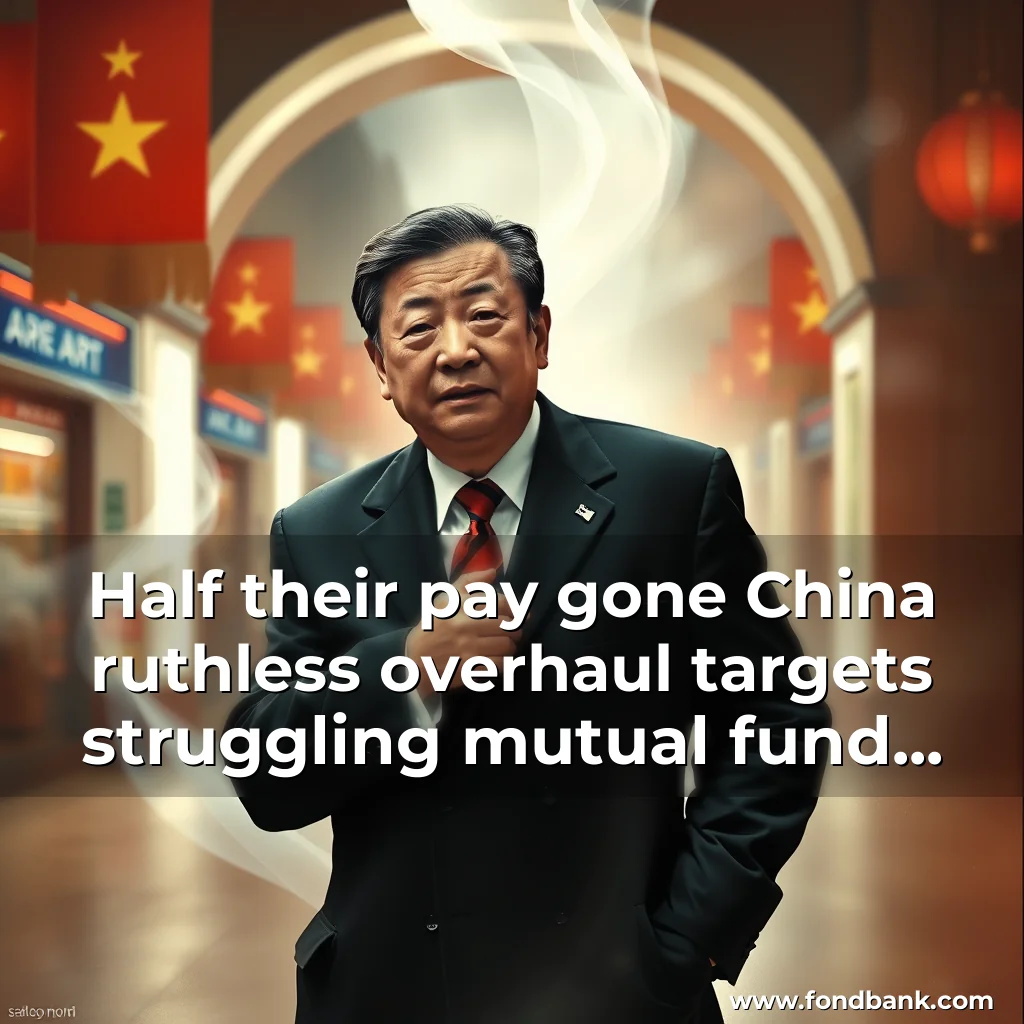
The Proposed Pay Cuts
The Chinese Securities Regulatory Commission (CSRC) has proposed a new regulation that would significantly impact the country’s fund management industry. The proposed rule would require fund managers to take a pay cut of up to 50% if their funds under management (FUM) fall below a certain threshold. This move aims to restore investor trust, improve fund performance, and attract long-term capital. • The proposed regulation would apply to all fund managers in China, including those managing private equity, hedge funds, and other types of investment vehicles.
The CSRC’s Directive and Its Impact
The China Securities Regulatory Commission (CSRC) has issued a directive for mutual funds to increase their onshore equity holdings by at least 10% annually over the next three years. This directive is part of a broader reform effort to reshape the country’s 33 trillion yuan ($4.6 trillion) mutual fund industry. The CSRC’s directive has significant implications for the mutual fund industry in China.
The Shift in Performance Evaluation
The traditional approach to evaluating senior management performance has been based on metrics such as firm size and ranking. However, a new draft plan suggests that these traditional metrics may no longer be relevant in the future.
A New Era of Performance Evaluation
The proposed changes to the performance evaluation framework will have a significant impact on the way senior management is evaluated.
and BlackRock Inc.
The Chinese government has been grappling with the challenges of the COVID-19 pandemic, and the ongoing economic downturn. The sector has been under pressure to adapt to changing consumer behavior and technological advancements.
The Chinese government has been signaling a shake-up in the sector, with Wu Qing hinting at impending reforms.
Market Trends and Analysis
The Indian stock market has been experiencing significant fluctuations in recent times, with the Sensex and Nifty indices moving up and down. This volatility has led to increased uncertainty among investors, making it challenging to make informed investment decisions.
The market volatility has significant implications for investors, including:
Despite the volatility, there are opportunities for investors to make informed decisions.
Top Performing Stocks in India
The Indian stock market has been witnessing a significant surge in recent times, with several top-performing stocks making headlines.
Strengthening Regulatory Frameworks
The Securities and Exchange Board of India (SEBI) has taken significant steps to enhance the regulatory framework around related-party transactions (RPTs) in the securities market.

news is a contributor at FondBank. We are committed to providing well-researched, accurate, and valuable content to our readers.