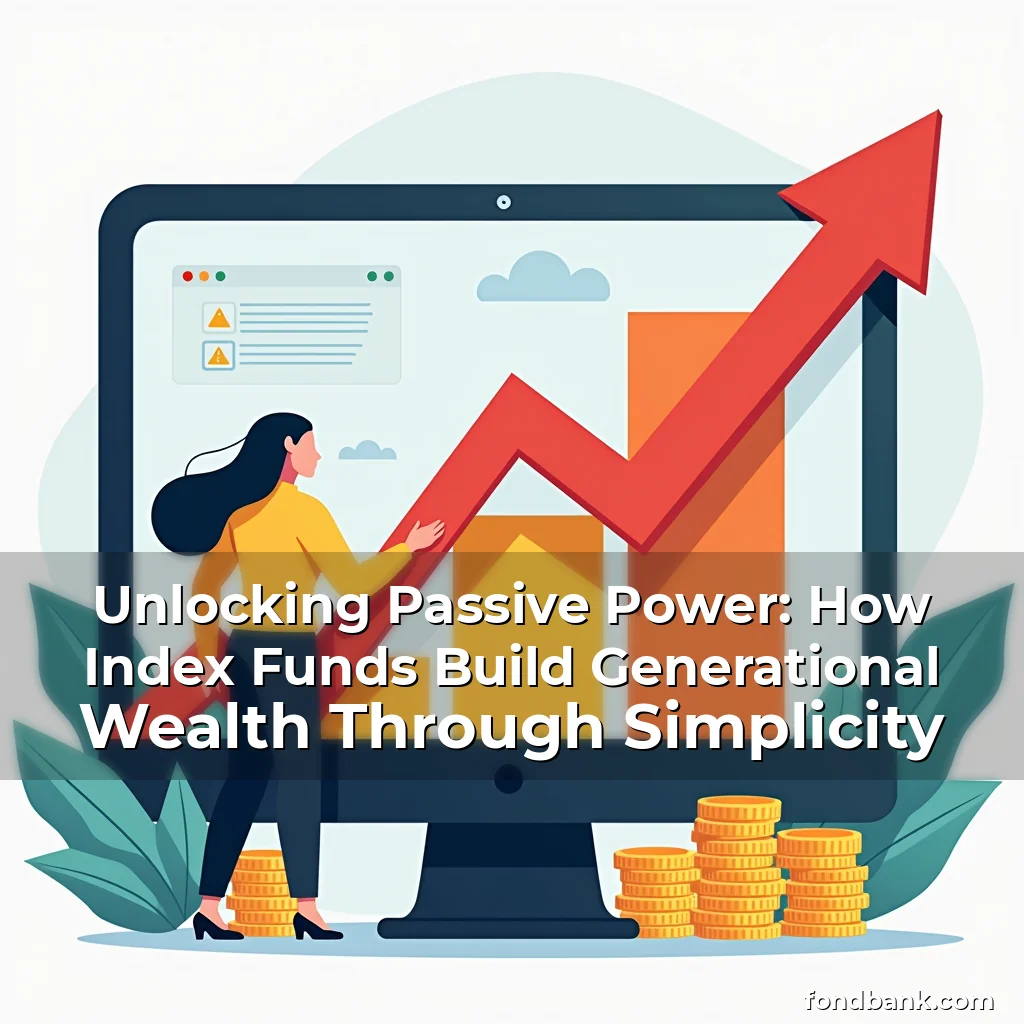
Unlocking Passive Power: How Index Funds Build Generational Wealth Through Simplicity
In a world where Wall Street traders chase fleeting opportunities, index funds offer a quiet but powerful alternative. These funds track entire stock or bond markets, allowing investors to capture average market returns without picking winners or losers. For retirees, young professionals, and anyone seeking consistent growth, index funds represent a revolutionary shift in investing.
Their appeal lies in simplicity—a single purchase grants access to hundreds or thousands of companies. With expenses averaging less than 0.1%, they outperform most actively managed counterparts while minimizing risk through diversification. This makes them ideal for building wealth over decades rather than trying to beat the market year after year.
The Science Behind Index Fund Success
At their core, index funds replicate the performance of a benchmark index like the S&P 500 or Russell 2000. By purchasing shares in every company within the index, investors gain proportional ownership of its total value. Unlike individual stocks, which depend on single-company fortunes, index funds distribute risk across the entire economy.
This approach follows the principles of modern portfolio theory, pioneered by Harry Markowitz. Diversification reduces unsystematic risk—the kind that comes from corporate failures or sector-specific shocks. When one component declines, others may rise, balancing overall returns. Over time, this steady accumulation of gains becomes the hallmark of successful long-term investing.
- Diversified Exposure: Owning 500+ stocks at once eliminates the need for complex research or timing decisions
- Cost Efficiency: Low expense ratios mean more capital remains invested instead of being siphoned off in fees
- Transparency: Daily performance tracking lets investors see exactly how their money aligns with market trends
Academic studies reinforce this model. Nobel laureate Eugene Fama’s efficient market hypothesis argues that predicting market movements is near impossible. Index funds embrace this reality, focusing instead on capturing broad-based growth. Their passive nature ensures investors benefit from compounding without emotional interference.
A compelling example comes from Vanguard, the pioneer of index funds. Since launching the first U.S. index fund in 1976, its S&P 500 fund has delivered annualized returns of approximately 10% before fees. Even modest contributions compounded over decades yield substantial results—an investor contributing $5,000 annually since 1980 would now own over $2 million.
The Mechanics of Market Tracking
Fund managers use two primary methods to mirror indexes: full replication and sampling. Full replication involves buying every security in the index, creating exact proportionality. Sampling selects representative securities to achieve similar weightings with lower transaction costs. Both approaches aim to minimize deviation from the target index.
Technological advancements have improved tracking accuracy dramatically. Algorithmic trading allows rapid adjustments when indexes change, reducing slippage from delayed purchases. Some funds even use derivatives to hedge against temporary imbalances, ensuring alignment with the index despite market fluctuations.
Tracking Error: The Invisible Drag on Returns
Despite meticulous design, index funds occasionally deviate from their benchmarks. This discrepancy, known as tracking error, arises from various sources. Transaction costs during rebalancing, dividend reinvestment delays, and rounding errors in fractional share calculations all contribute to minor divergences.
Experienced investors monitor tracking error metrics closely. A difference of 0.25% annually compounds significantly over time; over 30 years, this could erode up to 10% of total returns. Top-tier providers strive to maintain deviations below 0.1%, reflecting their commitment to precision.
Why Index Funds Outshine Active Management
The fee advantage alone explains much of index funds’ superiority. While active funds charge 1-2% annually, index funds typically operate below 0.1%. This 1% differential means an investor earning 8% annually in an active fund would effectively earn 7% net of fees, whereas an index fund investor retains the full 8%.
Performance data reinforces this pattern. Standard & Poor’s analysis shows that 85% of active equity funds fail to outperform their benchmarks over ten-year periods. Survivorship bias aside, the odds remain heavily stacked against professional pickers attempting to beat the market consistently.
- Tax Efficiency: Minimal turnover generates fewer taxable events, preserving after-tax returns
- Consistency: Avoids the volatility of manager changes or strategy shifts common in active funds
- Scalability: Enables small accounts to access institutional-grade diversification
Moreover, index funds eliminate behavioral biases that plague active investors. Emotional decisions to sell during dips or chase hot stocks rarely pay off. By adhering to a disciplined, rule-based approach, index funds mitigate the human factor that often derails investment goals.
Strategic Asset Allocation Using Index Funds
Beyond mere market replication, savvy investors leverage index funds for strategic positioning. Geographic tilts toward emerging markets, sector rotations, or fixed-income allocations allow customization while retaining the benefits of passive management. This flexibility creates tailored portfolios without compromising simplicity.
A typical balanced approach might allocate 60% to global equities via broad-market index funds, 30% to bonds through aggregate index funds, and 10% to commodities or real estate via specialized trackers. Such configurations balance growth potential with downside protection, adapting to changing economic cycles.
Global Reach Without Complexity
International index funds open doors to developing economies without requiring deep regional knowledge. An MSCI Emerging Markets fund offers instant exposure to Asia-Pacific, Latin America, and Africa—all with a single trade. Currency hedging options further reduce exchange rate risks for overseas investments.
However, investors should weigh local market dynamics carefully. Countries with unstable governments or volatile currencies present additional risks. Limiting foreign holdings to 20-30% of a portfolio provides diversification without overexposure to geopolitical uncertainties.
Timing the Market: Why It Doesn’t Matter
One of index funds’ greatest strengths is eliminating the need for precise entry/exit timing. Whether markets rise or fall, the fund maintains continuous exposure. This removes the pressure of predicting peaks and troughs, which few investors succeed at consistently.
Data supports this philosophy. Research from Morningstar reveals that investors who remained fully invested in U.S. stocks from 2000 to 2020 achieved 11.3% annual returns, compared to 8.6% for those who tried to time the dot-com crash and subsequent recovery. Patience proves far more effective than speculation.
Rebalancing becomes the focal point rather than timing. Quarterly or semiannual reviews adjust allocations back to original targets, selling appreciated assets to buy undervalued ones. This systematic approach maintains discipline without relying on market forecasts.
Risk Mitigation Through Diversification
While index funds inherently diversify across many companies, investors should still assess their personal risk tolerance. Younger individuals with longer horizons might lean toward growth-oriented indices, while retirees may favor income-generating alternatives like high-dividend index funds.
Sector rotation within index funds also plays a role. Technology-heavy indices carry higher volatility but greater growth potential, while utilities or consumer staples indices offer stability. Mixing different index categories helps manage overall portfolio variance.
- Market Risk: Cannot be eliminated entirely but is mitigated through broad diversification
- Liquidity Risk: Most index funds have high liquidity due to their popularity and underlying asset size
- Inflation Risk: Equity-focused indices historically outpace inflation better than fixed-income counterparts
Economic downturns test the resilience of index funds. During the 2008 crisis, the S&P 500 dropped nearly 50%, yet the fund itself didn’t collapse—it simply reflected the market decline. Investors who maintained positions recovered fully within five years, illustrating the power of staying invested through turmoil.
Choosing the Right Index Fund Provider
Selecting a reputable provider is crucial for optimal outcomes. Established firms like Vanguard, BlackRock, and State Street offer extensive index fund lineups with competitive fees. Smaller platforms may provide niche options but require careful scrutiny regarding liquidity and fund size.
Fund size matters significantly. Larger funds generally have narrower bid-ask spreads and more stable pricing. However, excessively large funds may struggle with liquidity during extreme market stress. Balancing scale with responsiveness ensures reliable execution at fair prices.
Evaluating Expense Ratios and Minimum Investments
Expense ratios appear deceptively simple but compound drastically over time. A 0.05% fee saves $50 annually on a $100,000 account—but doubles to $100 on $200,000. For retirement savings, even tiny differences translate into meaningful long-term gains.
Minimum investment thresholds vary widely. Many discount brokers offer commission-free index fund purchases with as little as $100 initial deposits. Others require higher minimums but provide enhanced customer support and personalized guidance for larger accounts.
Long-Term Growth Through Compounding
Compounding is the eighth wonder of the world, according to Albert Einstein. Index funds amplify this effect by reinvesting dividends automatically. Every cent earned grows exponentially, turning modest initial investments into substantial nest eggs over decades.
Consider a $10,000 lump sum invested in an S&P 500 index fund yielding 10% annually. After 30 years, this becomes $174,494—not including inflation-adjusted returns. Adding $5,000 yearly boosts the total to over $1.1 million, demonstrating the magic of dollar-cost averaging combined with compounding.
Regular contributions become essential for maximizing growth. Automatic transfers ensure consistent participation regardless of market conditions. This strategy smooths out price fluctuations and builds wealth steadily without emotional decision-making.
The Future of Index Fund Innovation
Technology continues reshaping index fund offerings. Smart beta funds blend traditional indexing with factor tilts toward momentum, quality, or value. ESG (Environmental, Social, Governance) focused indexes cater to socially conscious investors while maintaining market-tracking fundamentals.
Artificial intelligence enhances index construction by identifying optimal constituents dynamically. Machine learning models analyze earnings reports, industry trends, and macroeconomic indicators to refine index compositions continuously. These innovations preserve the essence of passive management while improving adaptability.
- Smart Beta: Adds systematic tilt toward specific characteristics without sacrificing diversification
- Thematic Indexes: Focus on megatrends like renewable energy or artificial intelligence
- Customizable Portfolios: Allow investors to build bespoke index-like exposures through robo-advisors
Despite these advances, the core principle endures: capturing market returns efficiently. As innovation progresses, index funds will continue evolving while remaining anchored to their foundational strength—simplicity and cost-effectiveness.
Conclusion
Index funds have transformed investing by making broad market participation accessible to everyone. Their combination of low costs, diversification, and proven performance offers a roadmap for sustainable wealth creation. From retirees to millennials, they provide equal opportunity to grow assets responsibly.
To begin, choose a reputable provider, select indexes aligned with your goals, and commit to regular contributions. Let the power of compounding work silently for you—because sometimes the best investments are the simplest ones.

news is a contributor at FondBank. We are committed to providing well-researched, accurate, and valuable content to our readers.