The Art of Strategic Stock Market Investing: Unlocking Long-Term Wealth Potential
In an era where financial independence is increasingly tied to personal investment strategies, understanding the intricacies of stock market investing has become essential. The global stock markets represent a dynamic arena where fortunes are made and lost daily, yet they remain the most accessible avenue for building long-term wealth.
This guide will explore advanced techniques and foundational principles that empower investors to navigate the complexities of equity markets while mitigating risks associated with volatile price movements. Whether you’re a seasoned investor or new to the world of stocks, these insights can transform your approach to capital allocation.
Understanding the Fundamentals of Equity Markets
At its core, the stock market functions as a marketplace where companies issue shares to raise capital from public investors. These securities represent fractional ownership stakes in corporations, granting shareholders voting rights and entitlement to dividends when declared by company management.
The New York Stock Exchange (NYSE) and NASDAQ stand as two of the largest exchanges globally, facilitating billions of dollars in trading activity each day. While traditional exchanges operate through physical locations, modern digital platforms enable round-the-clock access to international markets via online brokerage accounts.
Share prices fluctuate based on various factors including corporate performance metrics, macroeconomic indicators, geopolitical events, and investor sentiment trends. This volatility creates both opportunities and challenges for those seeking to build diversified portfolios.
Market indices such as the S&P 500 serve as benchmarks that track the overall health of entire sectors or economies. Investors often use these indices as comparative tools to evaluate individual stock performances against broader market conditions.
- Liquidity: High liquidity ensures assets can be quickly converted to cash without significant price concessions during market stress scenarios.
- Volatility: Price swings reflect risk levels inherent in different asset classes, influencing potential returns over time horizons.
- Diversification: Spreading investments across industries and geographies reduces exposure to sector-specific downturns.
Evaluating Investment Opportunities Through Financial Analysis
Careful due diligence involves examining key financial statements that reveal a company’s operational efficiency and profitability trends. Annual reports provide crucial data points regarding revenue growth rates, profit margins, debt-to-equity ratios, and return-on-investment figures.
Analysts employ fundamental analysis techniques to assess intrinsic value by comparing earnings multiples relative to industry peers. Metrics like P/E ratios help determine whether stocks appear undervalued or overvalued within their respective sectors.
Technical analysts instead focus on historical price patterns and volume data to predict future movement probabilities. Charting methodologies include trend lines, support/resistance levels, and candlestick formations that signal buying/selling opportunities.
Mixed approaches combining quantitative models with qualitative assessments tend to yield better results than relying solely on one analytical framework. Incorporating expert opinions from reputable research institutions adds another layer of validation before making commitments.
Quantitative Tools for Informed Decision Making
Modern investors leverage algorithmic screening processes powered by artificial intelligence to identify promising candidates efficiently. These systems filter thousands of equities simultaneously using customizable criteria related to valuation measures, momentum indicators, and dividend yields.
Portfolio managers utilize Monte Carlo simulations to model various economic scenarios and forecast probable outcomes under differing interest rate environments. Stress testing helps anticipate how holdings might perform during recessions or unexpected shocks.
Data visualization software enables clearer interpretation of complex datasets by presenting information graphically rather than numerically. Interactive dashboards allow real-time monitoring of portfolio allocations across different asset classes.
Cloud-based analytics platforms offer scalable solutions suitable for both individual traders and institutional investors seeking sophisticated modeling capabilities without requiring extensive technical expertise.
Developing Effective Risk Management Strategies
No investment strategy is complete without robust risk mitigation tactics designed to protect capital from excessive losses. Diversification remains one of the simplest yet most effective methods for reducing unsystematic risk associated with individual security selections.
Hedging instruments like options contracts and futures agreements allow investors to limit downside exposure while maintaining upside participation potential. Properly executed hedges can significantly enhance risk-adjusted returns profiles.
Stop-loss orders function automatically to exit positions at predetermined price thresholds, preventing emotional decision-making during sharp corrections. Trailing stop mechanisms adapt dynamically to changing market conditions.
Position sizing calculations ensure appropriate capital allocation proportions according to perceived risk levels. Maintaining strict discipline around entry/exit rules prevents overexposure to any single trade or asset class.
Time Horizon Considerations in Portfolio Construction
Investors must align their chosen time frames with their financial goals and risk tolerance levels. Short-term speculators typically pursue quick profits through active trading, whereas long-term holders prioritize compounding effects over extended periods.
Compounding gains accelerate exponentially when reinvested consistently over decades rather than attempting to time market cycles precisely. Historical data shows that even modest annual returns compound substantially after thirty years.
Retirement savers benefit particularly from dollar-cost averaging strategies that smooth out purchase prices by regularly contributing fixed amounts regardless of prevailing market valuations. This method reduces impact from temporary fluctuations.
Young professionals starting early enjoy considerable advantages due to the power of compound interest working progressively over longer accumulation phases. Time itself becomes an invaluable ally in achieving retirement objectives.
Building a Resilient Investment Portfolio Structure
A well-balanced portfolio integrates equities alongside other asset types such as bonds, commodities, and real estate alternatives. Allocating resources strategically among diverse categories helps buffer against correlated downturns affecting similar sectors concurrently.
Tactical asset allocation adjusts percentages periodically based on evolving economic landscapes rather than rigid adherence to static targets. Rebalancing routines maintain desired risk-return characteristics amidst shifting market dynamics.
Core-satellite strategies combine broad-market index funds with concentrated positions in select high-potential stocks. This hybrid approach balances simplicity with opportunity-seeking tendencies characteristic of successful investors.
Sector rotation techniques capitalize on cyclical patterns observed historically between different industries. Shifting emphasis towards defensive plays during bearish phases contrasts sharply with aggressive tech-sector bets during bull markets.
Navigating Regulatory Frameworks and Compliance Requirements
Compliance with legal regulations protects both investors and financial institutions involved in transaction processing activities. Understanding applicable laws governing insider trading practices safeguards against inadvertent violations carrying severe penalties.
Securities and Exchange Commission (SEC) filings mandate transparency requirements ensuring full disclosure of material information impacting share values. Regular reviews of Form 10-K and 10-Q documents inform investors about corporate governance structures and strategic directions.
Anti-money laundering protocols require verification procedures confirming identity credentials prior to account opening. KYC policies prevent misuse of financial services by illicit actors engaged in criminal enterprises.
Brokerage firms implement Know Your Customer (KYC) checks mandating documentation submission verifying source of funds legitimacy. These precautions mitigate reputational damage arising from association with fraudulent schemes.
Leveraging Technology Enhancements in Modern Trading Environments
Advances in fintech innovation have democratized access to previously exclusive financial tools now available through mobile applications and web portals. Real-time streaming quotes facilitate timely execution decisions matching rapidly developing situations.
Robo-advisory platforms automate portfolio construction based on user-defined preferences concerning age, income level, and risk appetite parameters. Algorithm-driven rebalancing maintains optimal diversification standards continuously.
Blockchain technology enhances settlement efficiencies by enabling instant transfers between counterparties eliminating delays caused by conventional clearinghouse intermediaries. Smart contract implementations further streamline compliance operations digitally.
Artificial intelligence applications detect anomalous behavior patterns indicative of market manipulation attempts or rogue trader activities. Machine learning models refine predictive accuracy continually through iterative feedback loops analyzing vast quantities of unstructured data sources.
Fostering Continuous Learning and Adaptation in Evolving Markets
Successful investors recognize the importance of ongoing education in staying competitive amid ever-changing regulatory landscapes and technological advancements reshaping traditional paradigms. Engaging with thought leadership materials expands knowledge bases beyond basic fundamentals.
Participation in investor forums fosters peer-to-peer networking opportunities sharing experiences gained through practical application rather than theoretical discussions alone. Collaborative problem-solving accelerates mastery curve progression rates significantly.
Attending industry conferences exposes participants to cutting-edge developments occurring across multiple disciplines intersecting finance domains. Cross-functional insights generate innovative ideas applicable to varied investment contexts.
Reading whitepapers published by leading academic institutions provides empirical evidence supporting established theories versus anecdotal claims circulating widely within enthusiast communities lacking rigorous scientific backing.
Conclusion
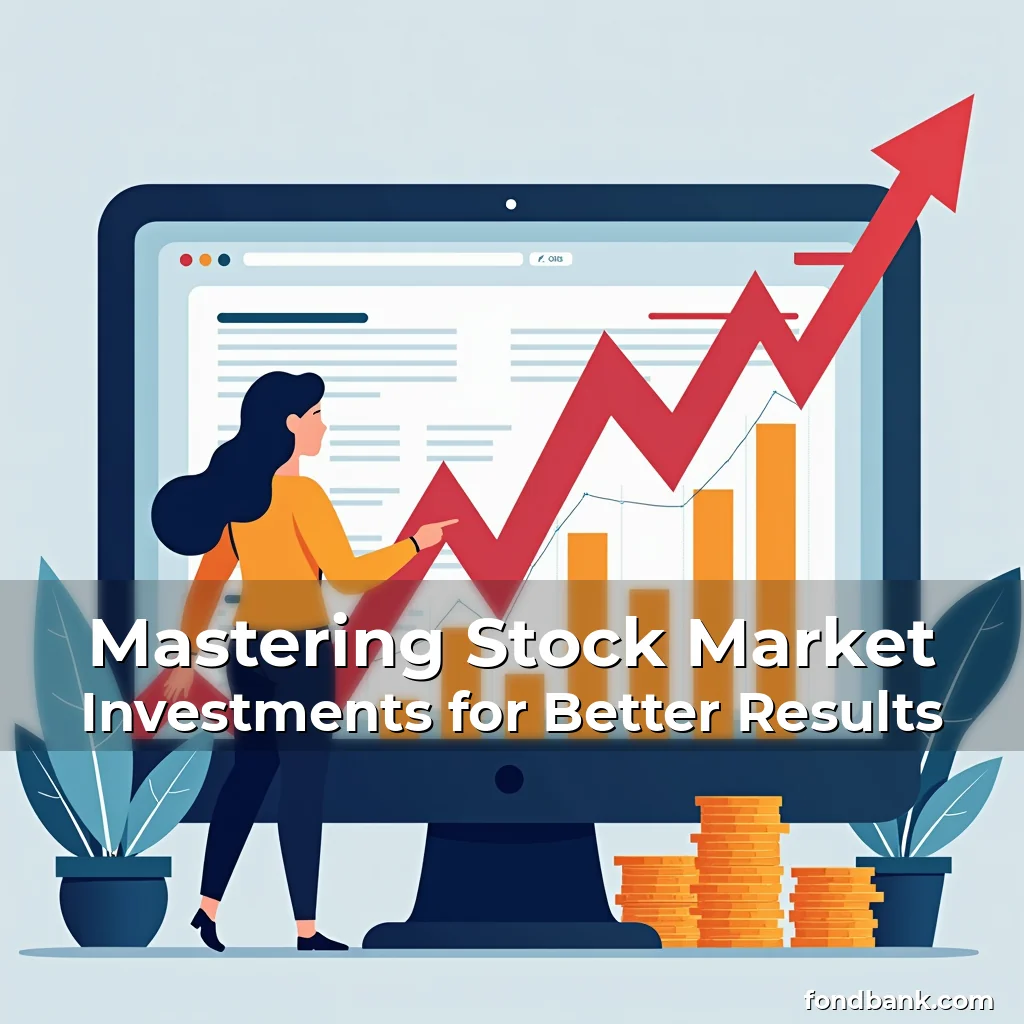
Mastering stock market investments requires blending analytical rigor with disciplined execution aligned closely with personalized financial aspirations. By adopting multifaceted approaches integrating both quantitative models and qualitative judgment calls, investors position themselves favorably against market uncertainties.
Continuous improvement through experiential learning combined with strategic adjustments ensures sustained success navigating unpredictable terrain characterized by perpetual change driven by human psychology and external forces alike.

news is a contributor at FondBank. We are committed to providing well-researched, accurate, and valuable content to our readers.