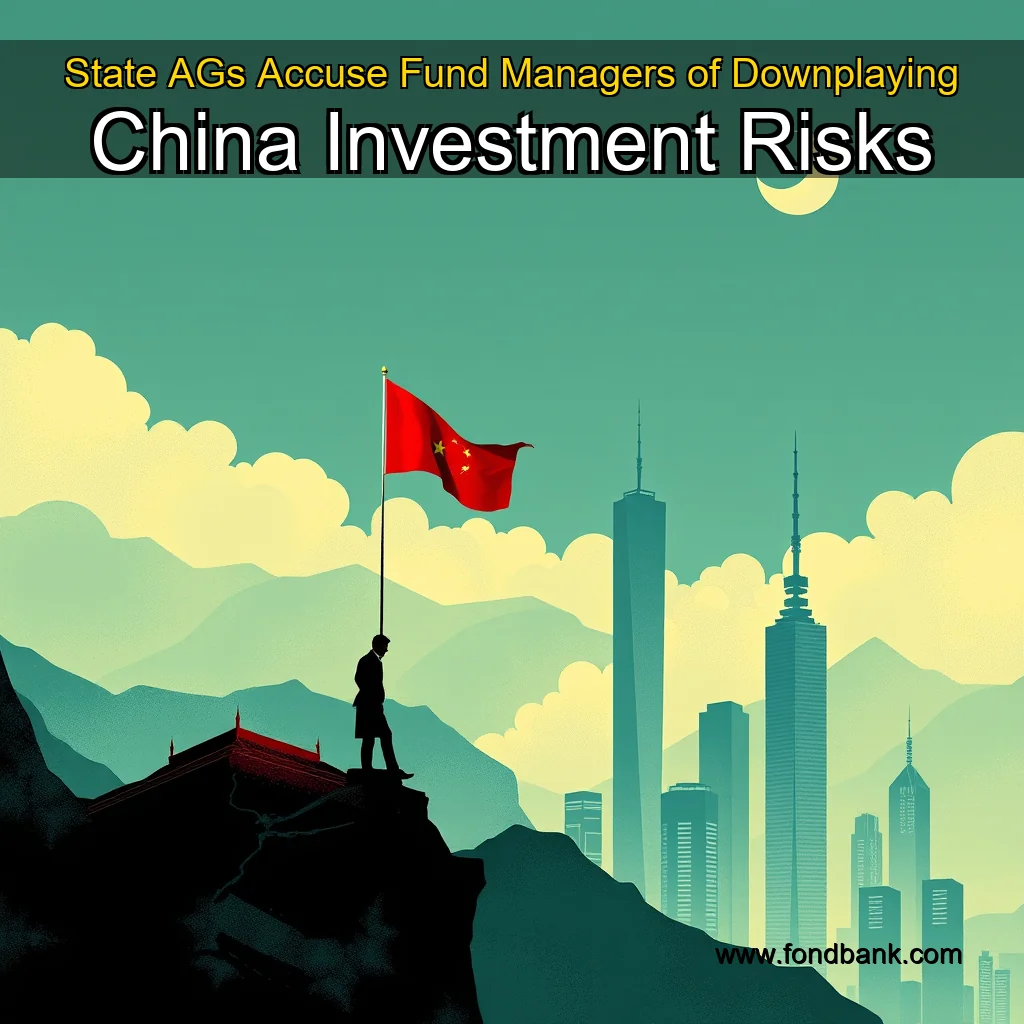
Misleading statements can have far-reaching consequences for investors and the financial industry as a whole.
The Misleading Statement
BlackRock’s statement was misleading because it downplayed the risks associated with investing in China. By implying that investments in China were at the same risk level as those in other countries, BlackRock was attempting to reassure investors that their investments were safe. However, this statement was inaccurate and potentially misleading. The risks associated with investing in China are unique and cannot be compared to those in other countries. China’s economic and political instability, as well as its complex regulatory environment, make it a high-risk market. BlackRock’s statement was an attempt to avoid drawing attention to these risks and to maintain a positive public image.
The Regulatory Implications
The attorneys general’s concerns about BlackRock’s statement have significant regulatory implications. The Securities and Exchange Commission (SEC) has the authority to investigate and take enforcement action against companies that make false or misleading statements to investors. The SEC has the power to impose fines and penalties on companies that violate securities laws. The SEC can also require companies to correct their statements and provide additional disclosure to investors.
Xinjiang’s troubled past and present collide in a crisis of human rights and cultural identity.
The Uyghur Genocide: A Growing Concern
The situation in Xinjiang, China, has been a topic of increasing concern for human rights organizations and governments worldwide. The Chinese government’s treatment of the Uyghur Muslim minority has been widely condemned, with allegations of forced labor, mass detentions, and genocide.
The Context
To understand the complexity of the issue, it’s essential to delve into the historical and cultural context of the Uyghur people. The Uyghurs are an ethnic group native to the Xinjiang region, which has been a crossroads of cultures and empires throughout history. The region has been influenced by various civilizations, including the Silk Road, the Mongols, and the Chinese Empire. The Uyghurs have a distinct language, culture, and Islamic faith, which has been a source of tension with the Chinese government. The region has experienced periods of autonomy and independence, but has also been subject to Chinese rule and assimilation policies.*
The Human Rights Crisis
The Chinese government’s actions in Xinjiang have been widely criticized for their severity and scope. Reports of forced labor, mass detentions, and genocide have been documented by human rights organizations, including Amnesty International and Human Rights Watch. Forced Labor: Uyghurs have been subjected to forced labor in industries such as textiles, mining, and construction. Mass Detentions: Thousands of Uyghurs have been detained in “re-education” camps, where they are subjected to forced labor, indoctrination, and torture.
The Background
The decision by Texas Governor Greg Abbott to order state fund managers to divest from China has sent shockwaves through the financial world. The move comes as tensions between the United States and China continue to escalate, with the U.S. imposing new sanctions on Chinese companies and individuals.
China’s growing stake in U.S.
This is a significant portion of the total $1.4 trillion in U.S. state and local government pension funds.
The Growing Importance of China in U.S. Municipal Pension Funds
A Large and Increasing Stake
The presence of China in U.S. municipal pension funds is a growing concern for policymakers and investors alike. With an estimated $100 billion to $200 billion in investment exposure, China has become a significant stakeholder in the U.S.